
Vein of Marshall Alcohol Ablation
Vein of Marshall (VoM) Alcohol Ablation is a procedure used for the treatment of atrial fibrillation and atrial flutter.
Patient Summary
The Vein of Marshall is a small vein in the left atrium of the heart. The muscle surrounding this vein may be a trigger and sustainer of atrial fibrillation and flutter. In this procedure we place a small balloon into the vein and then inject 9mls of concentrated ethanol. This creates a discrete and controlled scar eliminating this potential electrical pathway. The procedure is performed as part of the usual ablation procedure.
The VoM ethanol ablation cannot be completed in 10% — either because the vein is not present, or it cannot be safely entered. The risks of the procedure are similar to a conventional atrial fibrillation ablation and are listed below. However, inflammation around the heart — pericarditis — is more common (5%); it usually settles with simple anti-inflammatory medication.
Possible Complications
- cannot be done in 10%
- inflammation around the heart (pericarditis) (5%)
- pericardial effusion requiring drainage in 1/200
- stroke or transient ischaemic attack (TIA) 1/500 cases
- very rare risks include: need for pacemaker after the procedure, coronary artery spasm, anaphylaxis, and inadvertent isolation of the left atrial appendage, death in <1/1000
Anatomy
The VoM is an embryological remnant of the left superior vena cava. It has an occluded extra-cardiac portion — called the ligament of Marshall, and a patent intra-cardiac portion which runs from the left lateral ridge (between the left atrial appendage and left pulmonary veins) to the coronary sinus.
The VoM has a myocardial sleeve — the “Marshall bundle” — and is accompanied by autonomic nerve fibres. The Marshall bundle provides an electrical connection to the left atrium at the level of the left pulmonary veins, and has several discrete connections to the left atrium along its course.
Multiple studies show that the muscular fibres of the VoM are pro-arrhythmic — acting as a source of focal activity, participating in reentry circuits, and providing autonomic modulation.
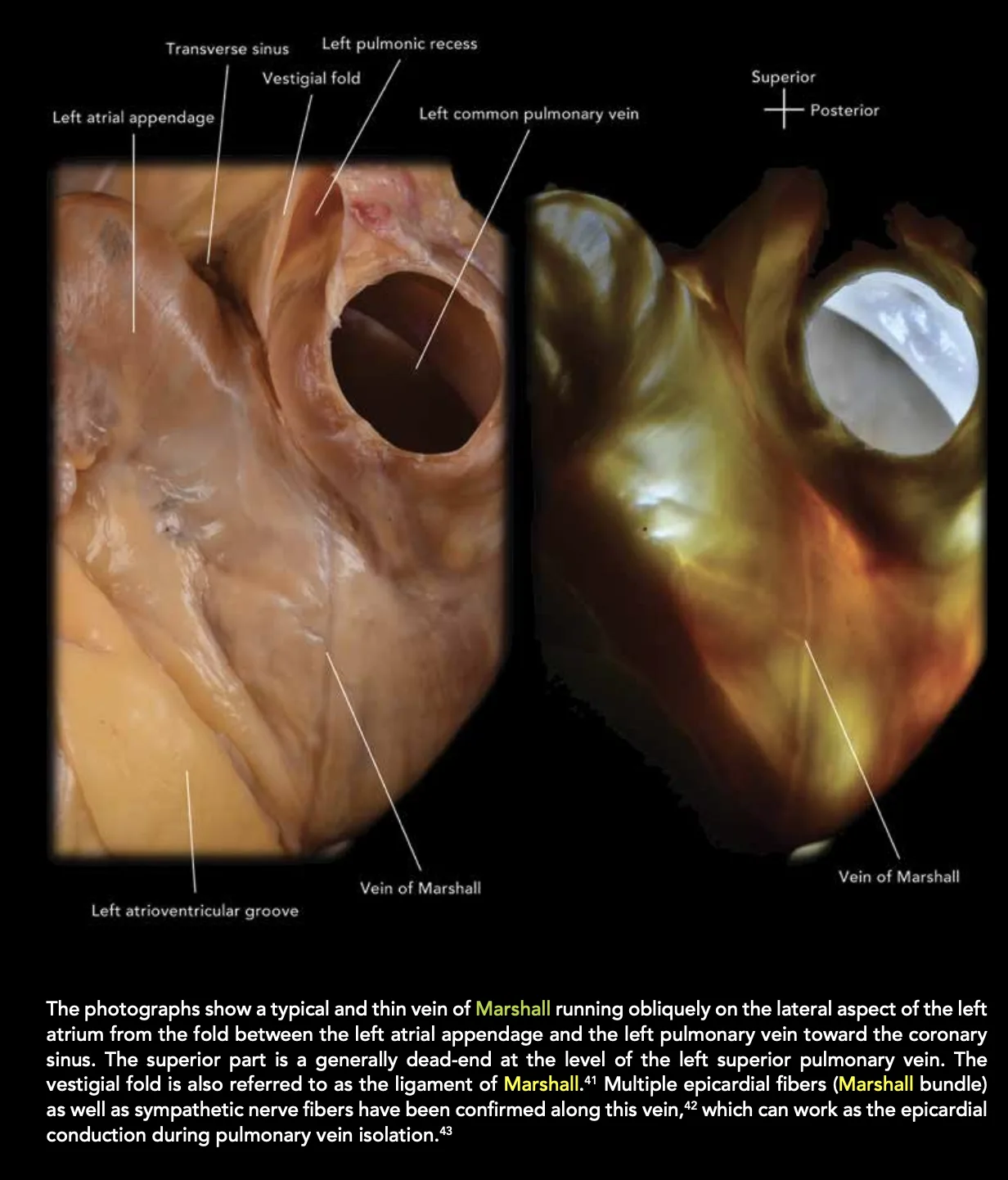
Anatomy of the vein of Marshall. Image reproduced from the Atlas of Interventional Electrophysiology (reference 10 below).
Further Reading
- Tzeis, S. et al. 2024 European Heart Rhythm Association/Heart Rhythm Society/Asia Pacific Heart Rhythm Society/Latin American Heart Rhythm Society expert consensus statement on catheter and surgical ablation of atrial fibrillation. Europace 26, euae043 (2024).
- Krisai, P. et al. How to perform ethanol ablation of the vein of Marshall for treatment of atrial fibrillation. Hear. Rhythm 18, 1083–1087 (2021).
- Derval, N. et al. Marshall-Plan Ablation Strategy Versus Pulmonary Vein Isolation in Persistent AF: A Randomized Controlled Trial. Circ.: Arrhythmia Electrophysiol. 18, e013427 (2025).
- Saleiro, C. et al. Ethanol Infusion in the Vein of Marshall for Persistent Atrial Fibrillation Ablation: Evidence From Randomized Controlled Trials. J. Cardiovasc. Electrophysiol. 36, 3014–3023 (2025).
- Gillis, K. et al. Vein of Marshall Ethanol Infusion as First Step for Mitral Isthmus Linear Ablation. JACC: Clin. Electrophysiol. 8, 367–376 (2022).
- Becker, B. D. et al. International Survey on Vein of Marshall Retrograde Ethanol Infusion. Circ.: Arrhythmia Electrophysiol. 18, e014049 (2025).
- Sang, C. et al. Pulmonary Vein Isolation With Optimized Linear Ablation vs Pulmonary Vein Isolation Alone for Persistent AF. JAMA 333, 381–389 (2025).
- Bola, H. et al. Ethanol infusion of the vein of marshall-based strategies for persistent atrial fibrillation: a systematic review and meta-analysis of randomized trials. Europace 28, euag069 (2026).
- Katapadi, A. et al. Tips and Tricks to Perform a Successful Vein of Marshall Alcohol Ablation. J. Innov. Card. Rhythm Manag. 16, 6424–6437 (2025).
- Tung, R., Mori, S. & Shivkumar, K. Atlas of Interventional Electrophysiology: Anatomical Basis of Cardiac Interventions, Volume 2. Cardiotext Publishing (2024). (Source of the anatomical figure above.)